College is overrated and having a degree does not mean you are more successful or better than those who do not have one. Don’t get me wrong (please do), I’m not suggesting that all universities are just glorified diploma dispensaries. But let’s face it, in the real world, your ability to master a Netflix binge often proves more useful than most of what’s crammed into a college syllabus.
I’ve mortgaged my soul for a cap and gown and I absolutely regret it. Here, let me share my thoughts and unpack whether this piece of parchment is the golden ticket everyone claims it to be, or just another expensive receipt for surviving endless lectures.
A HEARSE FOR YOUR PURSE – university is a business
The notion that knowledge – a fundamentally limitless and intangible resource – comes with a price tag might just be one of the greatest paradoxes of our time. To think that we must pay to learn seems almost ludicrous. Sure, using the physical facilities of a university, accessing professional services, and benefiting from the campus infrastructure – these are tangible goods and services that understandably incur costs. But should the act of learning, the simple conferment of knowledge, really be something that’s commoditized?
This commercialization of education creates an unsettling reality: it turns universities into gatekeepers of knowledge, where learning becomes a luxury item, accessible only to those who can afford the hefty entry fee. It shifts the focus from expanding minds to expanding wallets, from academic enrichment to profit margins.
What we’re left with is a world where the wealth of knowledge is locked behind paywalls, where students accumulate debt faster than wisdom, and where getting an education can feel more like a financial transaction than a journey of intellectual growth. Surely, if knowledge is power, shouldn’t we be more concerned with empowering minds rather than emptying pockets?
(I am sooooo indebted that I am indebted)
As we talk about universities acting more like businesses, we cannot ignore the elephant in the room – known as student debt. This isn’t just any debt; it’s the kind that follows you around like a bad credit score ghost haunting your financial dreams.
As of the second quarter of 2024, student loan debt in the U.S. stands at a staggering total of over $1.74 trillion. Yes, trillion, with a ‘T’—that’s the kind of number that’s more at home in discussions about national budgets or the box office earnings of a superhero franchise. More than 92% of this colossal figure is federal student loan debt, with the rest attributed to private student loans.
With such an astronomical amount of debt, graduating feels less like tossing a cap in the air and more like throwing a financial grenade into your future. You might start your career feeling less like a fresh graduate and more like a contestant on a game show where the grand prize is getting to zero.
Furthermore, this debt load is not just a number; it’s a heavyweight title that many carry, shaping their lives and choices. It dictates the jobs graduates take, the places they can afford to live, and the financial risks they can dare to take. And as for those personal milestones like buying a house or starting a family? Well, they might just have to wait until the next season of your life – hopefully, one with better ratings in your bank account.
So, while student loans are intended to democratize access to education, they often end up perpetuating inequalities. Those who can afford to pay for college outright start life with a clean slate, while others begin their professional journey looking up from the bottom of a financial pit. Is this the ‘fair start’ education promises?
As we consider the role of education in our society, let’s remember that while knowledge may be priceless, the degree that proves you have it certainly comes with a cost – a cost that millions are paying in more ways than one.
Knowledge is a right, not a privilege.
i would kill for (real) skills
The irony of a traditional college education is that it often prepares us for a world that doesn’t exist anymore – a world where theoretical knowledge is more valued than knowing how to do things that earn you money. It’s like being given a map to the stars when you just need directions to the nearest grocery store.
During my brief time at university, I encountered numerous geniuses who could effortlessly design complex, sustainable urban landscapes, yet found themselves stumped when trying to assemble a simple IKEA chair. (I am referring to myself lol)
Not to mention, there exists the world of vocational training and bootcamps. These are places where skills aren’t just taught; they’re wielded like weapons in the arena of the job market. Here, you learn by doing. It’s like choosing between reading a cookbook and actually cooking; one fills your head, the other fills your stomach.
In a twist that surprises exactly no one, these practical skills can lead to jobs faster than you can say “cum laude.” You might not have the alma mater sweatshirt to prove you spent four years losing sleep over exams, but you’ll have something better: a paycheck from a job where you actually use what you learned.
Why are we still sluttin’ it out for this piece of paper?
In a world where your grandma still thinks the only route to success involves a mortarboard, the pressure to go to college can feel like showing up to a Halloween party where everyone decided to dress as a graduate. Society loves a good degree. It’s like a backstage pass to the job market — or so we’re told. But here’s the kicker: many wander into the hallowed halls of academia without a map, a plan, or even a clue why they’re there, except for an unspoken rule that says a diploma is the ticket to the big leagues.
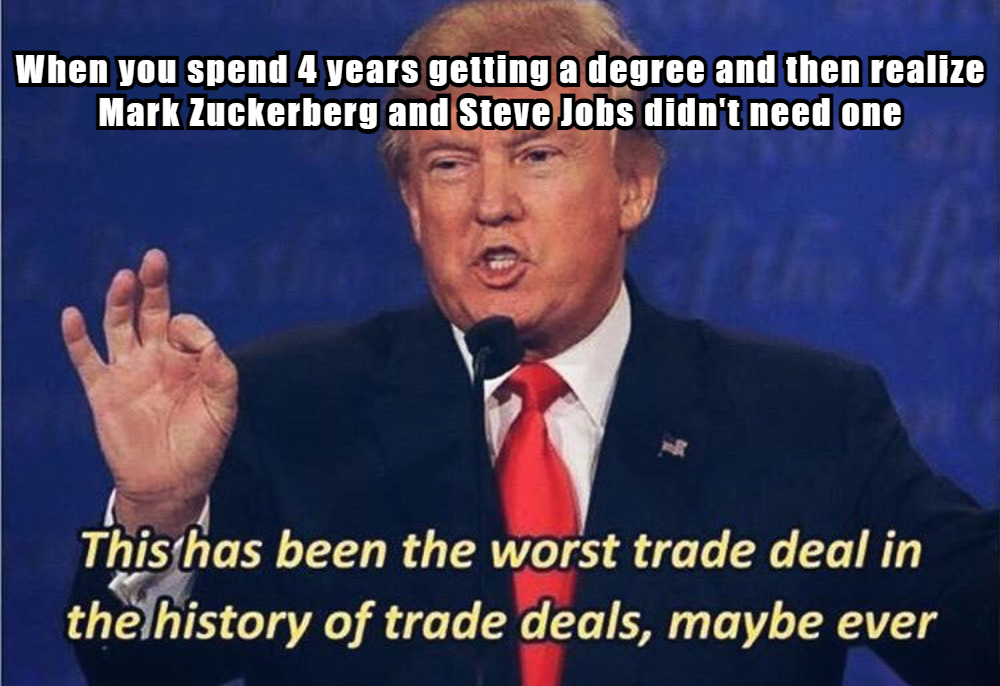
The reality? The job market is often as impressed with your expensive degree as a cat is with your new, pricey furniture – it might take a look, but it won’t stop shredding the cheaper options. And let’s not forget the success stories that break this mold. Think Steve Jobs, Mark Zuckerberg, and Ellen DeGeneres – who dropped out of college and dropped into fabulous wealth and fame. These outliers thumb their noses at convention, showing that sometimes the best class is the one you skip.
So before you sign up for a lifetime subscription to Student Debt Monthly, consider this: maybe the real success is figuring out what you want to do before you decide whether you need an ivy-covered wall to do it against. Because in the end, the most valuable degree might just be in knowing yourself.
The True Essence of Higher Education
“Educating the mind without educating the heart is no education at all”
Aristotle
Many of us have been conditioned to see knowledge as something that should be prescribed – a checklist of facts and theories spoon-fed by professors and neatly packaged into syllabi. Without this prescription, we might feel lost, unsure of how to proceed. This mentality is, quite frankly, the real problem. Whether intentionally or not, universities have become factories of this one-size-fits-all approach to learning.
But here’s the thing: real education is about more than just memorizing textbook theories or passing exams. The true essence of higher education should be about learning to learn. It’s about constantly questioning the world around us, challenging the practices we take for granted, and cultivating a sense of curiosity that goes beyond the lecture halls.
Instead of passively absorbing pre-set knowledge, we should be encouraged to dig deeper, to ask the uncomfortable questions. Why are things done this way? Could they be done better? What’s the real-world impact of what I’m learning? Universities should be places where students are encouraged to tackle real-world problems, not just theorize about them. They should be less about abstract concepts and more about engaging with the implications of our knowledge -connecting theory to practice.
In short, the goal of higher education shouldn’t be to churn out graduates with perfect test scores but to nurture critical thinkers, innovators, and individuals who are curious, adaptable, and ready to solve real-world challenges. The world doesn’t need more people following pre-prescribed paths; it needs more people who can forge their own.
 THE CONTRARIAN PRESS
Leave a comment